From Skeleton to Field Ready: The August Board Update
Ten minutes, five slides, and every open question the build still has. What went in front of the board since June 30, and what came back.
Ten Minutes to Cover Everything
Since the June 30 demo, this was the first time the full board saw the system again, this time over video from Florida with about ten minutes on the agenda. Five slides had to carry all of it: what shipped since June 30, what the next round of hardware costs, and every open question the build still has, station by station.
What Shipped
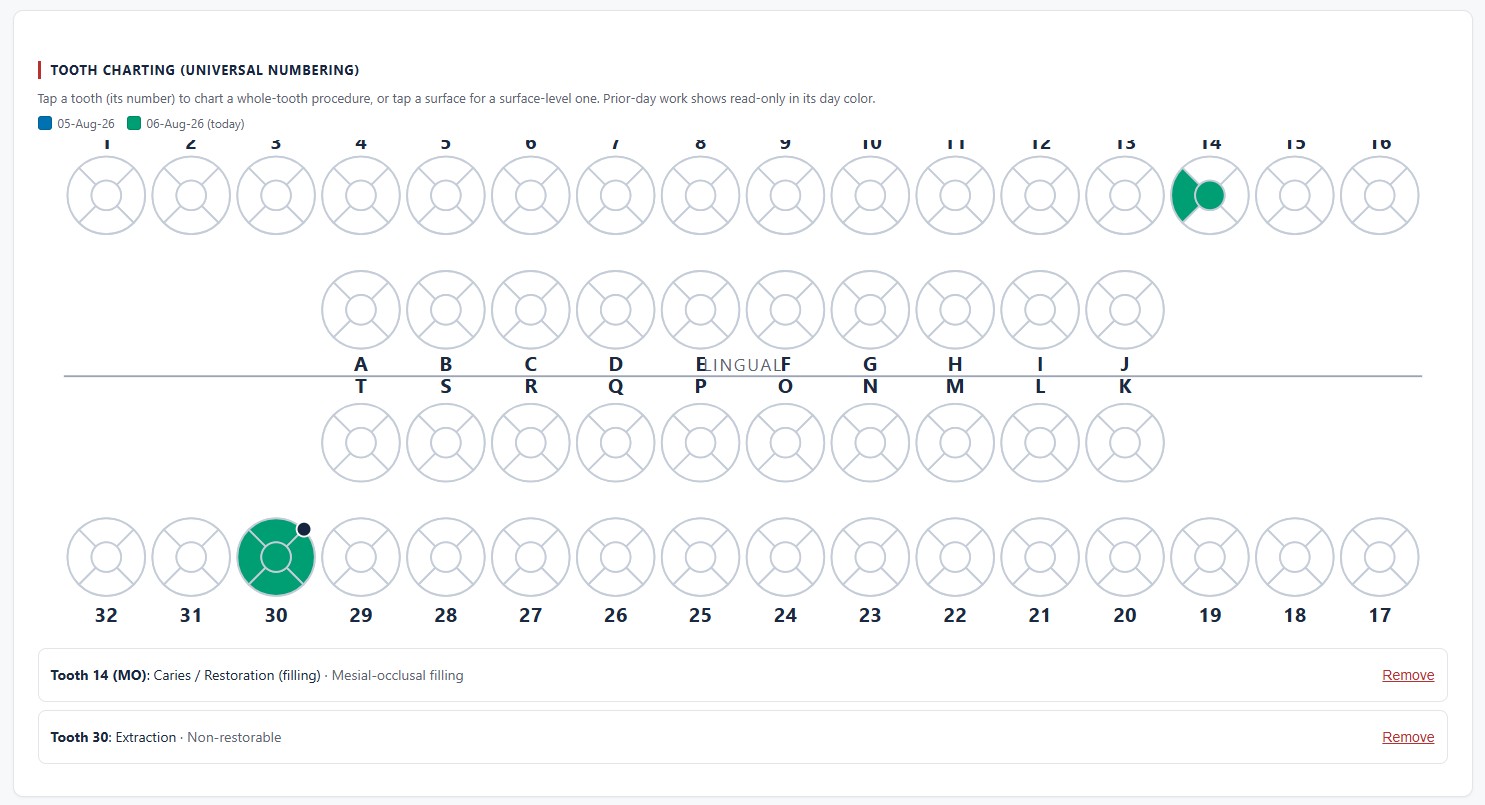
Registration, Triage, Medical, Vision, and Dental all moved since June 30. Registration now captures signed consent, tracks discharge status including rice-and-beans distribution, and warns on a duplicate patient at check-in. Triage adds pregnancy screening and the live station-routing card. Medical carries a patient problem list across missions and generates a review-of-systems narrative automatically instead of leaving it to free text. Vision has a structured doctor's exam and a freehand eye-diagram tool. Dental has the surface-level tooth chart, rebuilt to match the paper form, with per-day notes that keep prior-day work visible.
Behind the scenes: role-based logins, automatic backups, a full-mission Excel export, multi-site outreach IDs with an end-of-day merge, and the whole thing still runs fully offline. None of this needed a live demo to prove itself. The sandbox at clinic.mmdm.org now has 16 loaded practice patients, so anyone can go look directly.
The Hardware Ask
The next paperless step needs real hardware, and the board got real numbers instead of a vague estimate. Printers to replace handwritten patient slips and medication labels, tablets (one per station role, the figure that actually determines whether a station can run the EMR at all), an indoor access point pair for a signal gap that exists today, a switch, and outdoor Ethernet runs to reach them. Total: roughly $3,730 to $4,450, with tablets as the swing factor since no model is chosen yet and a $50 per-unit shift moves the total by $750. The ask was approval to go get firm quotes, tablets first, not a blank check.
Open Questions, Station by Station
Several of the open questions were ones Catherine Short had already started answering by email: whether allergies should move from admin-only editing to Triage, why a returning patient is never re-asked about them, what a nursing-charting space needs to capture, and what belongs on a durable-medical-equipment list. Putting the same questions in front of the full board wasn't redundant. It meant more people who actually run these stations could weigh in at once, instead of one lead carrying the whole review alone.
Dental's open item is the largest: does the rebuilt tooth chart actually match the paper original, do the tooth surfaces land where a dentist would describe them out loud, and is a flag enough for a patient returning to finish an extraction, or does that need a real waiting list. Linda saw the chart live for the first time, asked to see it again so she could screenshot it, and then asked the same question Catherine had asked by email three weeks earlier: can an extracted tooth be marked with an X. Two people who run the station independently landing on the same question is a good sign the question is real.
Vision is furthest from settled. The form is four tabs in station order (eye chart, autorefractor, doctor's exam, dispensing), each one locking once complete so a later change can't quietly undo work already agreed to. Two tabs are complete and locked, one is in progress, one hasn't started, and none of it is signed off yet. Three specific questions are open: whether the stocked reading-glasses range, the sunglasses categories, and the two-drug eye-drop list are right; whether the freehand marking pen's red option is confusing next to the app's own red allergy-warning color; and whether the tabbed form is the right call, or whether splitting it into four separate forms is worth the larger rebuild.
Medical has the biggest blocker. Two formularies exist in parallel now: the sig worksheet built directly into the app, still empty on all 96 drugs because nothing has been entered, and Dr. Condron's independently built 72-drug formulary, already through its own physician review round. Dr. Byrd has seen both and called them very similar, but hasn't picked one, and nothing gets entered into the app until that's settled. A dedicated call with both doctors together is now the ask, not another email thread. Separately, still undecided: whether the diagnosis field should become a real selectable list instead of free text, and doctor review of the ten-category review-of-systems checklist, still engineering's draft, not a clinician's.
One item didn't wait for a follow-up. The patient consent form's legal language is still a placeholder, and getting MMDM's own counsel connected before the mission was flagged as urgent, the one item that couldn't just join the open-questions list.
What Came Back
The reaction in the room was immediate and positive, the first time most of the board had seen the rebuilt system live since June 30. Roberto also raised something from an earlier conversation: whether patient ID bracelets are worth building toward. That had gotten a brief, early look before, not a real investigation, and the honest answer was that there hadn't been the bandwidth to go further. It's open now as an active question, with a follow-up call planned to actually settle whether it's viable.
One more thing came out of the room that wasn't on any slide: a volunteer couple interested in helping with IT, with an offer from leadership to make the introduction directly if they don't follow up on their own. Every hour of this build has come from one person since June 30. That offer matters as much as anything else that happened in those ten minutes.